
To the stars

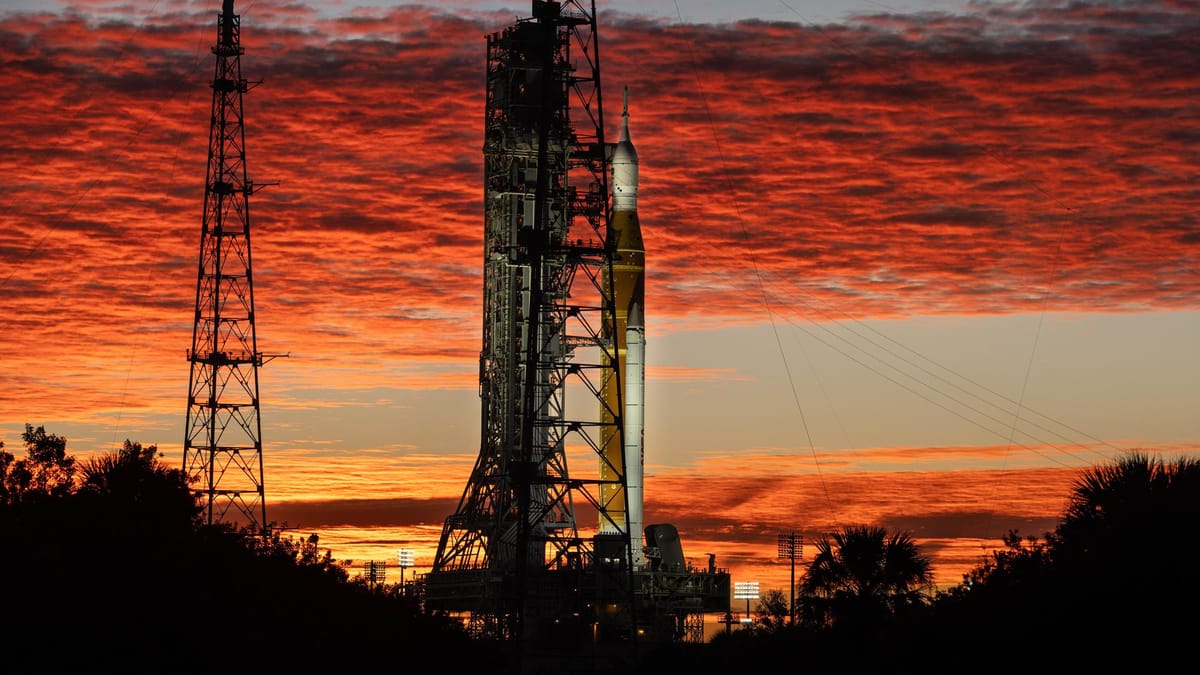
I watched today's Artemis 2 launch with gritted teeth. I am not an astronaut, nor will I ever be (an ex-girlfriend once told me my height prevented it, but she had clearly never heard of Jim Wetherbee). These days, I take semi-regular flights on Delta Airlines, and those are uncomfortable enough for me. Takeoff and landing are especially difficult. I endure these critical phases with a low-level panic that warns me the entire plane is going to burst into pieces. This anxiety is enhanced when I fly in a Boeing jet, but all planes spark a bit of fear in me.
Suffice to say: I don't envy anyone who is strapped to a rocket.
Lately, I also find myself wondering whether or not space travel is a worthy human endeavor at all. We live in a time of needless genocide and war, a time of pollution and upheaval, a time when American excess has become snarled with American decline in increasingly discomforting ways. Amidst all of this, we launch a rocket, making another moonward gambit while it's still on the table.
I'm mixed on this decision.
A rocket launch costs a lot of money (Artemis 2 seems to have cost around $4.1 billion) and generates a lot of emissions in a time when many experts agree we really, really, really shouldn't be doing that. There's a good argument to be made that it's unethical to hurl tons of steel at the moon when American citizens are being detained and killed by our own government. I think it's a good claim to say that maybe Artemis 2 represents a nation with misaligned priorities.
But there are good reasons to go to space too. We learn a lot when we do it. One of the more interesting experiments onboard Artemis 2 is designed to teach us about how human bodies and immune systems work. Maybe it's a good idea. I'm not sure. There are better ethicists than me (lots of them).
As I watched the launch today, I wondered what it was like to watch the old rockets go up. And it occurred to me that--despite the narrative we sometimes prefer--there is no uncomplicated history of rocketry. The Apollo 11 mission touched lunar soil in 1969, which turned out to be a politically turbulent year for the Americans who watched Armstrong take that small step. If our priorities were misaligned, theirs were too.
I was pretty small when I saw my first rocket launch. It would have been around 2000 or 2001 when my dad took our family out to the condominium parking lot, near the tennis courts, and launched a purple Estes rocket that soared high above the storage units and fences into the dark-blue of an after-work sky. I recall thinking that the rocket would never come down. But of course it did; I remember some consternation being expressed about where it was going to land.
That was not a good time in my family's life. It couldn't have been more than a few months later that we were forced to move, the cars repossessed, the condo foreclosed on. But you know something? We launched that rocket anyway. And I've thought about that rocket almost every month of my damn life. I was just a little kid, but two decades later I can still see that purple fuselage streaming far overhead, headed upward to kiss the stars.
And if you ask me? I'm not sure the rocket ever did come down. Because I can still picture it up there, looking down on a kid with a cold nose and telling him that it's going to be okay. That there are stars we don't yet know, and that they shine brighter than we can imagine.
Fly safe, Artemis 2.